Ships Between 4 to 7 Days
Order before 15:00 to expedite shipping
Secure Payments
Secured by OZOW and Paystack
Free Shipping for orders above R3000
We will ship your order for free to anywhere in SA - Our Gift to you!
Order before 15:00 to expedite shipping
Secured by OZOW and Paystack
We will ship your order for free to anywhere in SA - Our Gift to you!
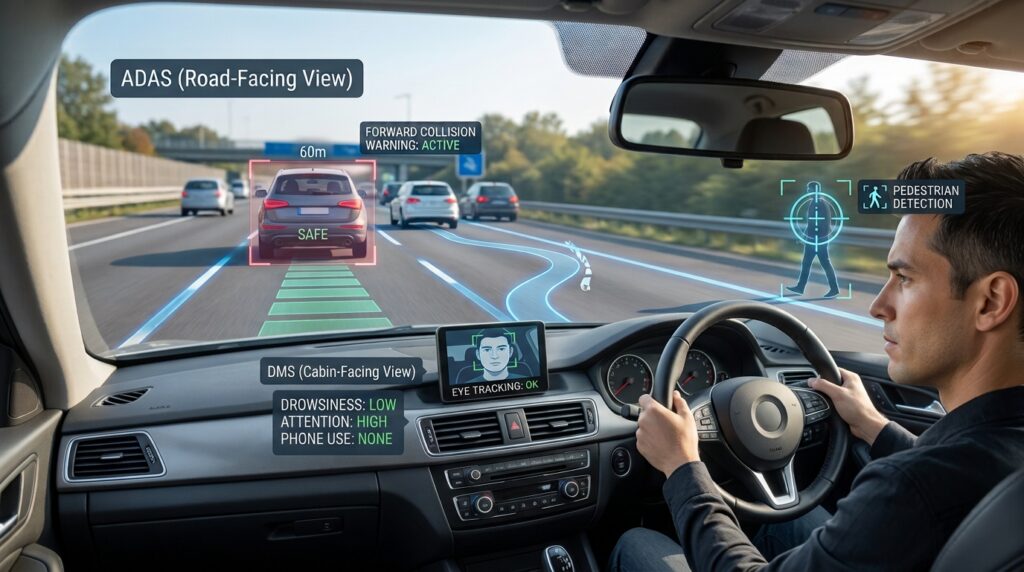
For years, dash cameras were seen as simple, passive recording devices—glorified webcams strapped to your windshield that sat silently until an accident occurred. If you were lucky, the SD card recorded the collision without corrupting the file.
Today, vehicle safety has undergone a massive shift. Passive dashcams are being rapidly replaced by AI-powered dash cameras equipped with Advanced Driver Assistance Systems (ADAS) and Driver Monitoring Systems (DMS).
An AI dash camera doesn’t just record accidents—it actively works to prevent them. Whether you are a daily commuter, a family driver, or a manager overseeing a commercial fleet, upgrading to an AI-driven smart dashcam is no longer a gadget upgrade; it is an essential line of defense on modern roads.
Here is everything you need to know about AI dash cameras, how ADAS and DMS protect you, and why this smart tech belongs in your vehicle.
Traditional dashcams record continuous loop video. They are reactive. You only look at the footage after something goes wrong—like a fender bender, a hit-and-run, or a disputed traffic ticket.
An AI dash camera, by contrast, relies on computer vision and edge-computing algorithms to analyze road conditions and cabin activity in real time. By processing video feeds millisecond by millisecond, the device acts as a digital co-pilot. It detects hazards outside the vehicle and risky behaviors inside the cabin, delivering instant spoken or visual alerts so you can react before an incident happens.
To deliver 360-degree safety, modern smart dashcams feature dual-camera setups that power two main technologies: ADAS and DMS.
ADAS refers to a suite of smart camera features focused on external road conditions. By continually scanning vehicles, lane markings, and pedestrians in front of you, an ADAS-enabled dashcam gives you critical seconds to respond to fast-changing traffic scenarios.
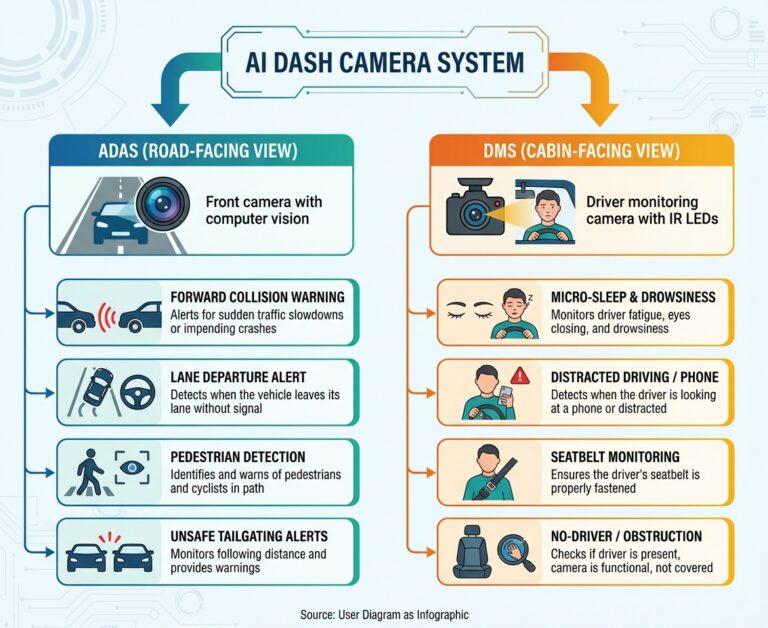
Forward Collision Warning (FCW): Measures the distance and relative speed between your car and the vehicle ahead. If traffic suddenly stops or you approach a car too fast, the system issues an immediate audible collision alert.
Lane Departure Warning (LDW): Detects road lane markers. If your car drifts out of its lane without an active turn signal—a clear indicator of distraction or fatigue—the dashcam sounds an alert to bring your focus back.
While ADAS looks out at the road, DMS turns its attention inward using a driver-facing camera equipped with infrared (IR) night vision.
Human error, fatigue, and distraction account for over 80% of road accidents. DMS uses facial tracking algorithms to evaluate driver state and eliminate human lapses before they turn dangerous.
Fatigue & Drowsiness Detection: The AI tracks eye closure duration, blink frequency, head tilts, and yawning patterns. If it detects micro-sleep or heavy fatigue, it emits high-priority audio alarms urging you to pull over and take a break.
Distraction & Smartphone Detection: Looking down at a text message for just five seconds at 55 mph (90 km/h) is equivalent to driving the length of a football field blindfolded. DMS instantly identifies mobile phone usage, texting, or looking away from the windshield for extended periods.
Unsafe Behaviors: Advanced DMS models detect smoking behind the wheel, seatbelt non-compliance, and obscured camera lenses, encouraging safer, more consistent driving habits.
Traditional dashcams only provide evidence after a crash. AI dash cameras actively reduce crash risks by giving you early warnings when reaction times are tightest.
“He-said, she-said” disputes after a collision can take months to resolve, often resulting in costly deductible payouts. An AI dashcam pairs ultra-clear 2K/4K front footage with GPS telematics, accelerometer force data, and cabin video. This provides ironclad proof to shut down insurance fraud, staged accidents, and false liability claims instantly.
Because AI dash cameras with integrated ADAS and DMS significantly reduce crash frequency, many insurance providers now offer premium discounts for drivers and commercial fleets using verified smart cameras.
Modern 4G LTE AI dashcams automatically upload critical incident clips—such as hard braking, sudden swerving, or collisions—directly to the cloud. Even if the physical camera is damaged or stolen, your high-definition footage remains safely stored online.
| Feature | Standard Dashcam | AI Dash Camera (ADAS + DMS) |
| Primary Purpose | Post-accident video recording | Real-time accident prevention |
| External Monitoring | Unprocessed passive recording | ADAS: Collision, lane-drift & tailgating warnings |
| Internal Monitoring | Basic cabin recording (if dual) | DMS: Real-time drowsiness, phone & fatigue alerts |
| Cloud Connectivity | Manual SD card transfers | Instant 4G upload during critical safety events |
| Impact on Risk | Zero hazard prevention | Up to 40%+ reduction in road collision |
Driving conditions are more crowded and distracted than ever before. Relying on a basic dashcam means settling for passive record-keeping when what you really need is an active safety assistant.
By combining ADAS road vision with DMS driver monitoring, an AI dash camera acts as an extra set of eyes that never gets tired, distracted, or blinkered. It protects your vehicle, defends your insurance record, and—most importantly—helps ensure you make it home safely on every trip.